PRETORIA – As political parties negotiate the future governing arrangement of the City of Tshwane, the record of the outgoing executive deserves scrutiny beyond election results, political alliances and competing claims about service delivery.
One area worth examining is the relationship between the City and organised labour, particularly the South African Municipal Workers' Union (SAMWU) and the Independent Municipal and Allied Trade Union (IMATU).
During Dr Nasiphi Moya's executive mayoral tenure, Tshwane experienced labour tensions, demonstrations and disagreements over outstanding salary increases. However, the administration also pursued negotiations that culminated in a settlement worth approximately R1.088 billion in backdated salary payments.
The development is significant because the dispute was not created by the current administration. It was inherited from the previous DA-led administration and had already developed into a prolonged legal and industrial relations dispute.
FROM COURT BATTLES TO THE NEGOTIATING TABLE
The dispute centred on outstanding salary increases, including a 3.5% increase for the 2021/22 financial year and a separate 5.4% increase for 2023/24.
On 9 May 2025, the Labour Court granted Tshwane an exemption from implementing the 5.4% increase, while referring the 3.5% dispute back to the South African Local Government Bargaining Council for a new determination.
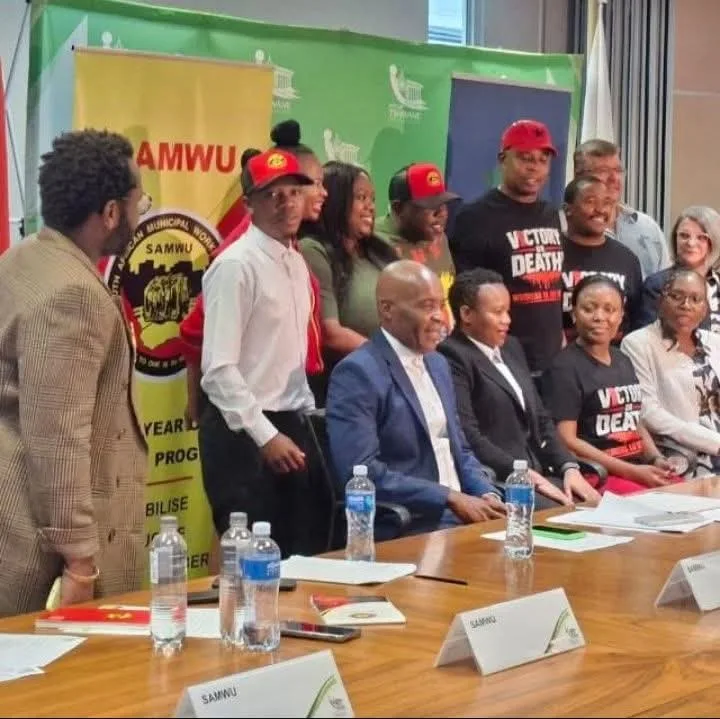
Rather than allowing the disagreement to remain exclusively within the courtroom, Moya's administration subsequently engaged SAMWU and IMATU.
The parties agreed to invoke Section 150 of the Labour Relations Act and pursue a CCMA-facilitated mediation process to resolve the 3.5% dispute.
This marked an important shift towards structured engagement between the municipality and its recognised trade unions.
The City's own account described the engagement as constructive and solution-oriented, with the parties acknowledging the financial and operational strain caused by the prolonged disagreement.
PROTESTS DID NOT DISAPPEAR
The administration's engagement with organised labour did not mean that tensions disappeared.
On 6 August 2025, SAMWU members marched to Tshwane House, demanding that the City honour the outstanding salary agreement and reinstate 44 employees dismissed following the industrial action associated with the earlier wage dispute.
The union also raised concerns about internal municipal capacity, insourcing, employment-related grievances and working conditions.
The City maintained that some of the union's demands had already been addressed, while explaining that the allegations against the 44 dismissed employees required individual investigations.
Corporate and Shared Services MMC Kholofelo Morodi told the media that the City had already insourced 100 cleaners and was preparing a second phase of insourcing.
The City also indicated that it was strengthening waste management capacity, including a commitment involving 75 waste trucks.
These developments demonstrate that the relationship between the executive and organised labour was not simply about negotiating salaries. It also involved discussions about municipal capacity, the use of contractors and the conditions under which municipal services are delivered.
The August protest remains an important part of the record. Equally, the executive's willingness to engage with the memorandum and respond to its demands should not be overlooked.
FEBRUARY 2026: THE R1.088 BILLION BREAKTHROUGH
The most substantial development came on 19 February 2026, when Moya announced that the City had reached an agreement with SAMWU and IMATU over the outstanding 3.5% salary increase.
The proposed settlement covered 21,089 municipal employees.
Under the agreement, employees would receive a 3.5% salary increase effective from 1 March 2026, with backpay calculated from 1 July 2021.
The total backpay liability was calculated at R1,088,004,733.95.
Rather than requiring the municipality to settle the entire amount immediately, the agreement provided for staggered payments over three years, prioritising lower-paid employees.
Importantly, employees leaving the City's employment through retirement or resignation were also to receive their outstanding backpay upon exit.
The settlement was subsequently taken to the Tshwane Council.
On 26 February 2026, councillors approved the settlement proposal by 105 votes to 69, authorising the City Manager to conclude an agreement with SAMWU and IMATU.
This was a significant institutional development: the settlement was not simply an announcement by the mayor. It received formal Council approval.
The agreement addressed the 3.5% salary dispute. It did not resolve the separate 5.4% increase, from which the City had obtained a Labour Court exemption.
BUILDING A WORKING RELATIONSHIP WITH ORGANISED LABOUR
The significance of the settlement extends beyond the monetary value.
Municipal employees are central to the delivery of basic services. Their relationship with the administration affects institutional morale, operational continuity and the City's ability to carry out its responsibilities.
A prolonged wage dispute creates uncertainty for employees and management alike. It can also create conditions for industrial action, litigation and interruptions to municipal operations.
By pursuing mediation and eventually reaching an agreement with both SAMWU and IMATU, the Moya executive demonstrated an approach that relied on negotiation with organised labour.
The process also required cooperation beyond the mayor's office. The City Manager, municipal administration, labour representatives and councillors all had roles in moving the settlement from negotiations to formal approval.
That institutional cooperation is worth recognising.
It does not mean every grievance has been resolved, nor does a signed salary settlement automatically establish that labour relations across the municipality are free of conflict.
The outstanding status of the 44 dismissed employees and other grievances raised by SAMWU must still be assessed against subsequent developments and documented outcomes.
Nevertheless, the settlement represents a measurable outcome in a dispute that had remained unresolved for years.
WHY THIS MATTERS DURING COALITION NEGOTIATIONS
The 2026 Local Government Elections have placed Tshwane's political future back on the negotiating table.
ActionSA has publicly indicated that it wants Moya to remain executive mayor for another five years, while expressing its willingness to negotiate with parties prepared to commit to a shared programme of governance.
The negotiations are taking place in a politically contested environment, where the incoming administration will require sufficient support in Council to govern.
However, coalition discussions should not be limited to which party receives the mayoral position, which party controls particular MMC portfolios or how political representation is distributed.
They should also consider institutional continuity, the stability of the municipal workforce, relationships with organised labour and the ability of the administration to resolve inherited disputes.
The SAMWU and IMATU settlement provides one concrete example of a governance challenge that moved from prolonged disagreement towards a negotiated resolution.
For parties considering Tshwane's next administration, the question should therefore include what happens to these institutional relationships after the political negotiations are concluded.
Will the incoming executive maintain the engagement mechanisms established with organised labour? Will it continue addressing outstanding employment grievances? Will the financial commitments contained in the settlement be honoured according to the approved payment schedule?
These are practical questions with consequences for municipal employees and residents.
THE RECORD: PROGRESS AND OUTSTANDING QUESTIONS
Moya's executive cannot claim that there were no labour disputes during its tenure. SAMWU demonstrated outside Tshwane House, disagreements persisted and not every demand was resolved through the wage settlement.
But it would equally be inaccurate to assess the administration without acknowledging the progress made.
The executive inherited a prolonged wage dispute, engaged the unions, pursued mediation, negotiated a settlement worth more than R1 billion and secured Council approval for the arrangement.
That is a documented governance outcome.
The broader test will be whether the settlement is implemented as approved and whether the remaining labour grievances receive meaningful attention.
As Tshwane enters another round of coalition negotiations, the city's labour relations record deserves a place in the conversation.Political coalitions may determine who occupies the executive offices. But the stability of the municipality also depends on the relationships built between political leadership, municipal management and the employees responsible for keeping the city running.