
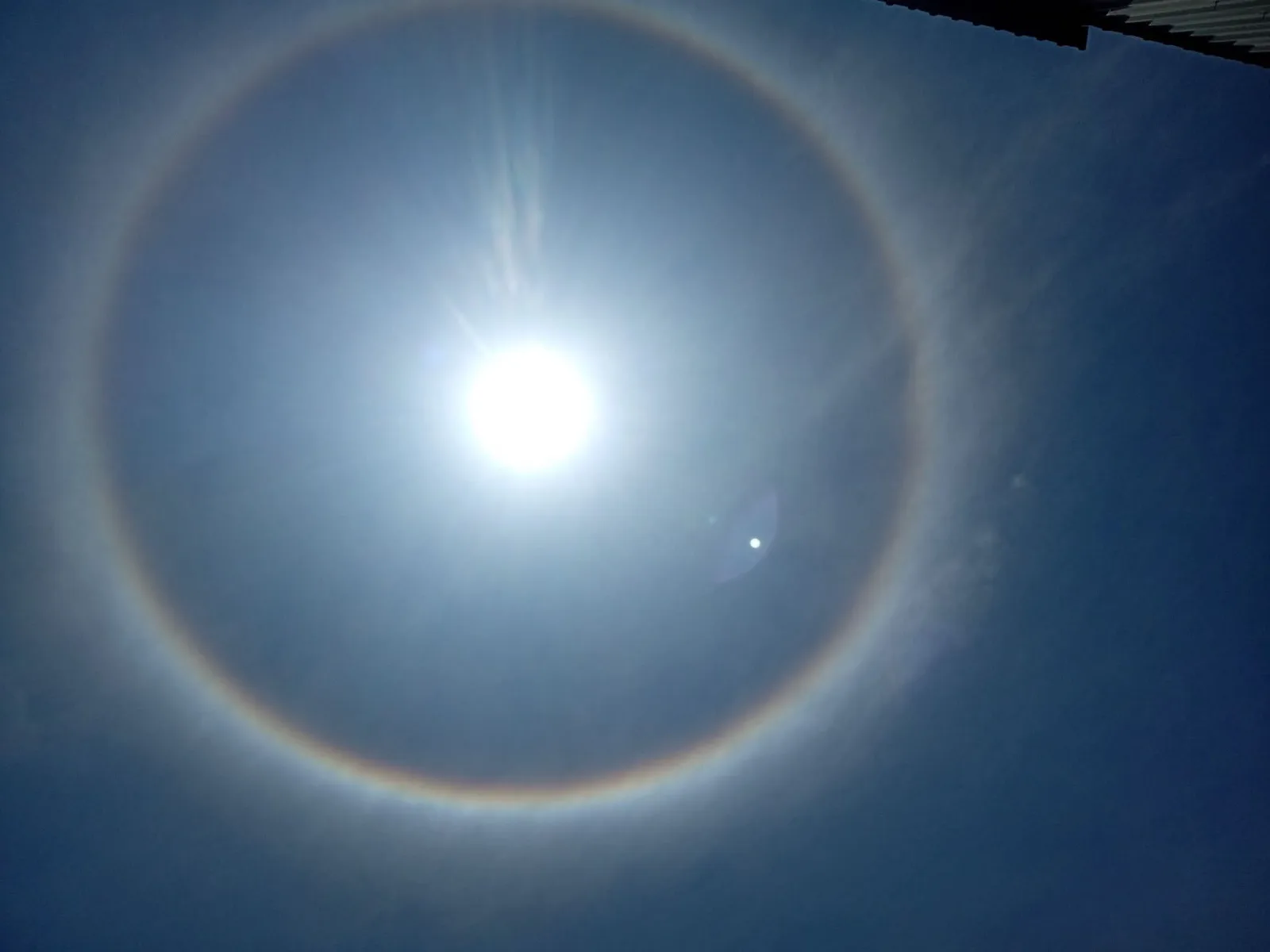
The phenomenon is commonly known as a 22-degree solar halo, a naturally occurring optical effect caused by sunlight interacting with ice crystals in high-altitude clouds.
The ring forms when sunlight enters and exits the faces of these ice crystals, bending the light at an angle of approximately 22 degrees. This creates the circular appearance, while the different wavelengths of light produce the subtle colours visible along the ring.
Why has it been appearing repeatedly? The repeated observations over recent weeks raise an interesting question about prevailing atmospheric conditions.
Their presence can sometimes indicate an approaching weather front. In certain circumstances, this may be followed by changing cloud conditions and rainfall. However, the appearance of a solar halo does not guarantee rain or severe weather.
Why has it been appearing repeatedly?
The repeated observations over recent weeks raise an interesting question about prevailing atmospheric conditions.
Solar halos are commonly associated with cirrus and cirrostratus clouds. These clouds form at high altitudes and can extend across large areas of the sky.
Their presence can sometimes indicate an approaching weather front. In certain circumstances, this may be followed by changing cloud conditions and rainfall. However, the appearance of a solar halo does not guarantee rain or severe weather.
The recurrence of the phenomenon could therefore reflect repeated periods of favourable high-altitude cloud conditions rather than an unusual solar event.
Is there any reason for concern?
There is no established scientific basis for treating a solar halo as evidence of an impending disaster, unusual solar activity or an atmospheric emergency.
It is an established atmospheric optical phenomenon that has been documented by meteorologists and atmospheric scientists around the world.
Nevertheless, the observation provides an opportunity to pay closer attention to atmospheric conditions and the changing appearance of the sky.
What makes today's observation particularly interesting?The photograph captured on Monday, 16 November, shows a particularly well-defined circular formation, with the ring extending around almost the entire circumference of the Sun.
The image also illustrates how atmospheric conditions can produce striking optical displays without requiring any unusual activity from the Sun itself.
Capital Daily News will continue to document notable environmental and weather-related observations, distinguishing established scientific explanations from speculation.Safety note: Never stare directly at the Sun to observe a halo. Use an obstruction, such as the edge of a building, to shield your eyes.